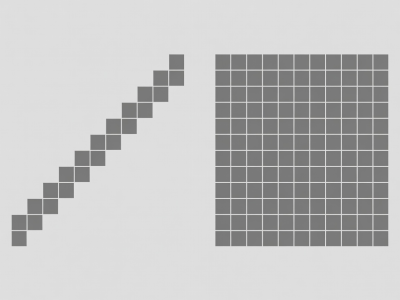
 Whole-Cell Mean
Staircase Aliasing
Matching only a single average value per tile turns diagonal contours into jagged sawtooth steps that force the viewer to step far back.
Every true photographic mosaic lives in a state of productive tension. If the macro image dominates completely—because the tiles are microscopic or drowned beneath a heavy colour tint—the viewer might as well be looking at a standard single-exposure poster passed through a texture filter. Conversely, if the individual tiles are too large, high-contrast, and tonally unruly, the overarching form collapses into a noisy contact sheet.
Balancing tile and whole is not a software slider problem; it is an optical geometry problem rooted in spatial frequency. Early pioneers of grid-based perceptual images—from Leon Harmon and Kenneth Knowlton’s 1973 Bell Labs symbol matrices to Salvador Dalí’s 1976 painting Gala Contemplating the Mediterranean Sea (which resolves into Abraham Lincoln at twenty metres)—understood that human vision separates high-frequency detail from low-frequency mass according to physical viewing angle.
Suppose you divide a portrait target into 1,200 square cells. A naive matching method measures only the single average lightness and colour of each target cell and drops in a photo with the same overall mean. That works across flat skies or plain coats, but fails along crucial diagonal edges like a jawline, a bridge cable, or a roofline.
To keep macro contours crisp without shrinking the tiles to unreadable specks, evaluate each candidate photograph across a 3×3 internal sub-grid (nine zones per tile). When the macro composition calls for a dark-to-light transition running from top-left to bottom-right across cell `R4-C7`, select a small photograph that naturally contains a dark upper-left sky or wall and a bright lower-right foreground.
Whole-Cell Mean
Matching only a single average value per tile turns diagonal contours into jagged sawtooth steps that force the viewer to step far back.
 Sub-Cell Vector
Selecting a tile whose internal shadow line mirrors the macro contour preserves smooth diagonal continuity even in coarse 24×30 grids.
Before setting column and row counts, ask where the finished work will live. In a narrow hallway where viewers cannot step back further than 1.5 metres, a mosaic built from 40 mm tiles will never fuse into a coherent macro image—the angular subtense of each tile on the retina remains too wide. In a lofty foyer viewed from 5 metres, 10 mm tiles vanish into anonymous grain.
| Print Width | Primary Viewing Distance | Close Inspection Distance | Recommended Tile Width | Approximate Grid Count (4:3) |
|---|---|---|---|---|
| 60 cm (24 in) | 1.8 m | 0.35 m | 12 mm – 15 mm | 48 × 36 (1,728 tiles) |
| 90 cm (36 in) | 2.7 m | 0.45 m | 18 mm – 22 mm | 45 × 34 (1,530 tiles) |
| 120 cm (48 in) | 3.8 m | 0.50 m | 24 mm – 30 mm | 44 × 33 (1,452 tiles) |
| 180 cm (72 in) | 5.5 m | 0.60 m | 30 mm – 40 mm | 52 × 39 (2,028 tiles) |
Notice that the total number of tiles stays remarkably stable—between 1,400 and 2,000 cells—regardless of physical print size, because human viewers naturally step back proportionally to the overall frame width while stepping in to a constant reading distance to inspect individual frames.
The single most common reason a mosaic stalls during assembly is a bell-curve archive. When a photographer shoots 800 frames on a sunny afternoon, roughly 70% of those frames cluster in the mid-tone luminance bracket (40% to 65% lightness). When you attempt to assemble a target portrait that requires deep 10% shadow anchors in the hair and 88% highlight tiles across the forehead, the archive runs dry in five minutes.
To prevent forced repetition or artificial darkening, build a deliberate Luminance Ledger before shooting finishes:
Once your tonal shelves hold at least forty distinct photographs per tier, move to Colour Fields to control how chroma and temperature move across those luminance steps.