Cropping: Cut with a Purpose
Every camera sensor or film gate hands you a default rectangle—usually 3:2 on 35mm full-frame, 4:3 on medium-format digital backs, or 1:1 on classic 6×6 roll film. Accepting that factory aspect ratio uncritically for every cell in a composite work is like a mason trying to build an arched doorway using only uncut quarry boulders.
In studio critique, we treat the crop tool as a structural knife. Where the knife falls determines two things: how weight sits inside the individual tile, and how fast the viewer’s eye exits that tile toward its neighbour. By cutting away context—removing the ground beneath a staircase or slicing a column vertically down its fluted shaft—you transform a descriptive snapshot into a directional geometric vector.
Sequential Crop Strip: Four Cuts of One Subject
Observe how the exact same architectural elevation behaves under four distinct crop decisions. None of these cuts is inherently "better" in isolation; each performs a different mechanical job inside a larger grid.
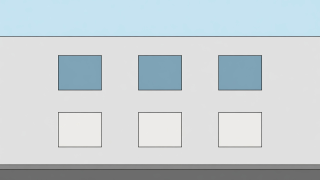
Self-Contained Rest
Leaving breathing room around all four sides keeps the eye inside the frame. Useful for standalone prints, but resists bonding with neighbours.

Diagonal Corner Lock
Cropping tight to a square so roof diagonals enter the exact corners transforms a building into an X-braced structural tile.
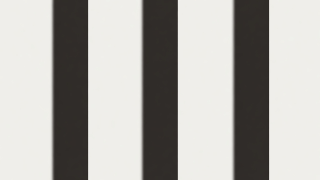
Upward Thrust
Eliminating horizontal cross-beams creates a rapid vertical conduit that links upper and lower rows of a polyptych.
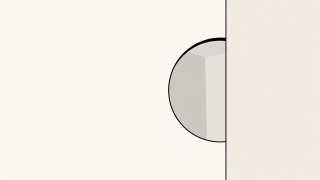
Active Seam
Cutting directly through the midpoint of an arch at the right border demands an immediate answering shape in the adjacent right-hand tile.
False Continuity Across Unrelated Frames
One of the most rewarding techniques in geometric collage and mosaic work is false continuity (sometimes called trans-gutter linkage). Take a photograph of a diagonal banister shot in London and place it immediately to the left of a diagonal shoreline photographed in Cornwall. If you crop both frames so the banister exits the right border of Tile A at precisely 58% height and the shoreline enters the left border of Tile B at 58% height with a matching 32-degree slope, the human visual cortex stitches the two unrelated worlds into a single continuous line.
To execute false continuity reliably without guesswork, lay a transparent ruler grid or guide overlay across your working canvas with horizontal ticks at 25%, 50%, and 75% of cell height. Crop your source files so major linear boundaries—horizons, table edges, limbs, tree trunks, or shadow lines—terminate squarely on one of those three registration marks.
Managing Tangents and Border Friction
In classical single-frame photography, instructors warn against "bad tangents"—where a subject’s contour barely kisses the frame edge without either clearing it cleanly or being decisively sliced. In multi-frame compositions, tangents take on a second dimension because four frame edges meet at every interior corner.
- The Decisive 20% Slice Rule: If a crop line touches a recognizable form (a wheel, a doorway, a head), either leave at least 10% margin outside it or slice at least 20% into the form. Skimming the outer two millimetres creates uncomfortable optical friction.
- Modular Aspect Ratio Families: When combining unequal frame sizes in a Bento or De Stijl layout, stick to integer subdivisions of a base unit (for example: 1×1, 1×2, 2×2, and 2×3 cells with uniform gutter widths subtracted). That ensures outer edges align cleanly across the entire wall.
Next, see how cropped frames combine into larger repeating structures in Collage: Turn Repetition into Rhythm.