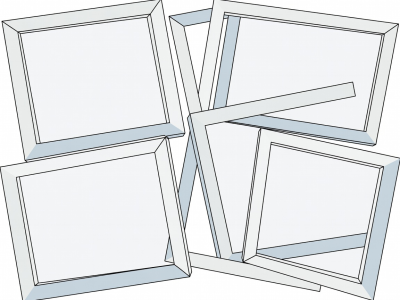
 Pan & Tilt Joiners
Multi-Point Perspective
Instead of rotating the camera on a tripod nodal point for a seamless panorama, step sideways between frames so each tile records its own vanishing point.
What separates mechanical repetition from visual rhythm? In music and architecture alike, repetition is simply the recurrence of an identical unit (`A–A–A–A`), whereas rhythm arises when units vary in duration, accent, interval, or orientation (`A–B–A–C` or `A–a–B–A`). When you lay out multiple photographs on a studio table, the human brain immediately hunts for the underlying rule governing the pattern—and takes pleasure when that rule is established and then subtly bent.
From Hannah Höch’s Dadaist photomontages and Ray K. Metzker’s darkroom composites of the 1960s to contemporary geometric paper weaves, photo-collage succeeds when the physical or digital joins participate actively in the rhythm of the piece.
Pan & Tilt Joiners
Instead of rotating the camera on a tripod nodal point for a seamless panorama, step sideways between frames so each tile records its own vanishing point.
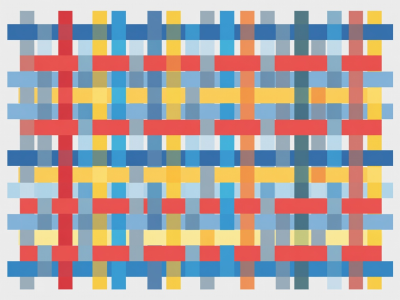 Interlaced Weave
Two contrasting prints—such as a positive and negative exposure or winter and summer views—are cut into 15 mm strips and woven into a single checkerboard matrix.
 Bookmatched Quartet
Reflecting a strong diagonal photograph across horizontal and vertical axes creates diamond or chevron stone-bookmatch patterns across a 2×2 module.
How two frames meet is just as expressive as what appears inside them. Consider three distinct join grammars:
| Join Grammar | Spatial Mechanics | Optical Effect on Rhythm |
|---|---|---|
| Flush Butt-Join (0 mm Gutter) | Edges touch directly with no mount board showing between cells | Maximises cross-border line fusion and simultaneous colour contrast; fast visual flow |
| Measured Grid Gutter (3 mm–12 mm) | Uniform architectural channel of dark umber or parchment between tiles | Introduces a steady rest beat between frames; calms chaotic internal detail |
| Shingled Overlap & Deckle Cut | Upper frames cast physical or vector offset shadows across lower neighbours | Foregrounds time and sequence; clearly signals which frame was laid down last |
Once you establish a clear repeating cadence—say, four rows of six vertical archway studies—introduce a single deliberate anomaly at the golden section of the matrix (for instance, Row 3, Column 4). That anomaly might be a frame where the arch is bricked in, a tile with inverted warm-gold tonality, or a double-width horizontal span that bridges Columns 4 and 5.
Without the strict regularity of the surrounding twenty-two tiles, the anomaly would have nothing to push against; without the anomaly, the twenty-four tiles risk reading like wallpaper. Have questions about troubleshooting specific grid joins? Visit our Clarifications page or send your layout measurements through Reach Out.